In a case of first impression, the U.S. Court of Appeals for the Seventh Circuit has ruled that the termination of two leases prior to a commercial tenant’s bankruptcy filing were transfers under the Bankruptcy Code and thus avoidable.
The case — In re Great Lakes Quick Lube LP — involved debtor Great Lakes, which operates oil change centers through lease-backs from investors. Great Lakes identifies and purchases the property, sells it to an investor, then leases it back.
A couple of months before filing bankruptcy, Great Lakes terminated several of its leases with an investment group, T.D. Investments. T.D. then leased two profitable Great Lakes locations to another oil change company.
Great Lakes’ creditors contended that the pre-petition termination of the two leases was avoidable as preferential or constructive fraudulent transfers. A bankruptcy court ruled that the lease terminations were not transfers. In addition, the court said even if they were transfers, they were not avoidable.
On appeal, the 7th Circuit reversed the bankruptcy court, holding that the termination of the two leases could be considered transfers under the Bankruptcy Code. In addition, the appeals court said that Great Lakes may not have received proper value for terminating the leases and remanded the matter to the bankruptcy court to determine the value of the transfers and whether T.D. could defend its fraudulent transfer claims.
The attorneys at Glass & Goldberg in California provide high quality, cost-effective legal services and advice for clients in all aspects of commercial compliance, business litigation and transactional law. Call us at (818) 888-2220, send an email inquiry to info@glassgoldberg.com or visit us online at glassgoldberg.com to learn more about the firm and to sign up for future newsletters.
The U.S. Supreme Court recently split 4-4 in a case involving whether or not the spousal guaranty rule under Regulation B is enforceable, for now making the question of enforceability dependent upon where the dispute arises.
In Hawkins v. Community Bank of Raymore, Valerie Hawkins and Janice Patterson brought suit against Community Bank of Raymore, alleging that the bank forced them to sign guaranties on a commercial loan made to their husbands’ company simply because they were married to the two men who jointly owned the company. Neither Hawkins nor Patterson had an ownership interest in the company. The bank allegedly refused to extend credit to the husbands without a spousal guaranty.
Regulation B prohibits the requirement for anyone to guaranty a loan just because they are married to the guarantor. This prohibition was applied because guarantors as applicants are protected under the Equal Credit Opportunity Act (ECOA), which prohibits discrimination “against any applicant, with respect to any aspect of a credit transaction… on the basis of race, color, religion, national origin, sex or marital status, or age.”
The case came before the U.S. Supreme Court via the 8th Circuit, which found that Regulation B does not apply to guaranties, noting that “the plain language of the ECOA unmistakably provides that a person is an applicant only if she requests credit. But a person does not, by executing a guaranty, request credit.”
The 8th Circuit’s ruling is in conflict with rulings on similar cases from the 4th and 6th Circuits, which found ECOA to be ambiguous as to the qualifications of an “applicant” and making Regulation B’s extension to guarantors permissible.
The split decision means that the spousal guaranty rule remains in place outside the 8th Circuit. However, the ECOA prohibition against lenders requiring a spousal guaranty if the applicant otherwise meets a lender’s requirements for creditworthiness still applies in all jurisdictions.
The attorneys at Glass & Goldberg in California provide high quality, cost-effective legal services and advice for clients in all aspects of commercial compliance, business litigation and transactional law. Call us at (818) 888-2220, send an email inquiry to info@glassgoldberg.com or visit us online at glassgoldberg.com to learn more about the firm and to sign up for future newsletters.
The U.S. District Court for the Northern District of California has ruled that a third party may compel arbitration if the issues in dispute are “intertwined with the agreement” to arbitrate.
The case — Henson, et al. v. Turn, Inc. — involves two Verizon subscribers in a putative New York class action who sued Turn to prevent it from monitoring Verizon subscriber activity via “secret supercookies.” Turn is an online marketing platform that has an agreement with Verizon to use subscriber data in order to deliver targeted ads to those subscribers.
In a motion to dismiss the suit or stay the action, Turn invoked an arbitration clause within the service agreement between Verizon and its subscribers, even though Turn itself was not a signatory to those agreements. Verizon’s service agreement did disclose that Verizon partners with other companies to provide targeted ads to subscribers.
The plaintiffs argued that Turn could not compel arbitration because it was not a party to the arbitration agreement. However, the court found that the plaintiff’s claims regarding the alleged unlawful use of “supercookies” by Turn were “inextricably intertwined” with the arbitration agreement. Applying New York law, which governs the Verizon service agreements, the court held that the plaintiffs could be compelled to arbitrate because signatories cannot avoid arbitration with a nonsignatory when the issues in dispute “are intertwined with the agreement.”
The court sent the case to arbitration and stayed the dispute pending the outcome of the arbitration.
The attorneys at Glass & Goldberg in California provide high quality, cost-effective legal services and advice for clients in all aspects of commercial compliance, business litigation and transactional law. Call us at (818) 888-2220, send an email inquiry to info@glassgoldberg.com or visit us online at glassgoldberg.com to learn more about the firm and to sign up for future newsletters.
A panel of the U.S. Court of Appeals for the Ninth Circuit has reversed a California court’s order compelling arbitration of a franchise agreement, finding that the agreement was not binding because there was no mutual consent to be bound.
In Casa Del Caffe Vergnano v. Italflavors, Cesar and Hector Rabellino formed Italflavors LLC in order to open an Italian coffee shop in the U.S. In September 2010, the Rabellinos traveled to Italy to meet with franchisor Casa Del Caffe Vergnano and the parties signed two agreements: (1) a franchise agreement that contained an arbitration clause specifying that all disputes would be settled by binding arbitration under United Nations Commission on International Trade Law arbitration rules with Geneva as the venue; and (2) a hold harmless agreement designed to allow Hector Rabellino to obtain a U.S. work visa that explicitly stated, “This contract does not produce any affect between the parties, who as agreed will sign a future contract which will regulate their commercial relationship as soon as it is prepared in accordance with the federal and national laws of the United States of America.”
Italflavors opened a Caffe Vergnano franchise in San Diego in April 2011 and the store closed eight months later. Italflavors sued Caffe Vergnano, saying that the franchisor did not provide the promised support to the franchise, which led to its failure. In May 2013, a federal judge in the Southern District of California issued an order compelling arbitration, holding that the issue of whether the arbitration clause survived the second agreement was a matter for the arbitrator to determine.
In a 2-1 decision, the Ninth Circuit panel said that when parties to a contract have not mutually agreed to be bound by the agreement, there is no contract. The panel found that the franchise agreement was not a contract, and was therefore unenforceable.
The attorneys at Glass & Goldberg in California provide high quality, cost-effective legal services and advice for clients in all aspects of commercial compliance, business litigation and transactional law. Call us at (818) 888-2220, send an email inquiry to info@glassgoldberg.com or visit us online at glassgoldberg.com to learn more about the firm and to sign up for future newsletters.
The U.S. Court of Appeals for the Ninth Circuit has ruled that a Chapter 20 debtor who is ineligible for a discharge may still void a lien if a lender fails to defend its claim.
In In re Blendheim, the Blendheims owned a condominium with two mortgages. They first filed Chapter 7 to discharge their unsecured debts, and then filed Chapter 13 to restructure the two mortgages on their residence — a process known as “Chapter 20.” The senior servicer, HSBC, filed proof of claim, which the debtors challenged on the grounds that HSBC only attached the deed of trust, and not the promissory note, to the proof of claim, and that one of the signatures on the promissory note was allegedly forged.
HSBC did not respond to the challenge and the bankruptcy court entered a default order disallowing HSBC’s claim. Subsequently, the Blendheims sought to void the mortgage under 11 U.S.C. § 506(d), which provides that “[t]o the extent that a lien secures a claim against the debtor that is not an allowed secured claim, such lien is void.”
In its ruling, the Ninth Circuit said that while “[v]oidance of a lien posed a more drastic consequence than simple disallowance of HSBC’s claim in the bankruptcy proceeding” because “voiding the lien would eliminate HSBC’s state-law right of foreclosure,” HSBC’s failure to defend its lien was equivalent to forfeiting its claim.
In addition, the court found that a debtor’s ineligibility for a discharge does not prohibit the permanent voidance of a lien under § 506(d), dismissing HSBC’s argument that a discharge was necessary in order for a debtor to attain the benefits of lien voidance since discharge is the only way to close a Chapter 13 case in a way that makes lien voidance permanent.
The attorneys at Glass & Goldberg in California provide high quality, cost-effective legal services and advice for clients in all aspects of commercial compliance, business litigation and transactional law. Call us at (818) 888-2220, send an email inquiry to info@glassgoldberg.com or visit us online at glassgoldberg.com to learn more about the firm and to sign up for future newsletters.
The Superior Court of California, County of Sacramento, has granted a preliminary injunction to halt Wells Fargo from foreclosing on a home, finding it likely that the homeowner would prevail on his claim that the bank engaged in improper “dual tracking” in violation of the California Homeowners Bill of Rights (“HBOR”) and would suffer great injury if the home was sold.
“Dual tracking” occurs when a lender simultaneously considers a borrower for a mortgage loan modification and proceeds with a foreclosure action. HBOR went into effect in January 2013 to provide California borrowers with a private cause of action to enforce the protections granted by the National Mortgage Settlement and subsequent new servicing standards mandated by the Consumer Financial Protection Bureau (“CFPB”).
In Sese v. Wells Fargo Bank, Daniel Sese received a Notice of Default on his Fair Oaks, California, home in January 2013. He then applied for mortgage assistance from Wells Fargo. On May 9, 2013, Sese received a letter from the bank stating that all his documentation had been received and that he was being considered for a loan modification. Two days later — on May 11, 2013 — Sese received another letter from Wells Fargo notifying him that his home was scheduled to be sold on June 4, 2013. Sese provided evidence to the court that he never received written notification from Wells Fargo that his loan modification application had been rejected.
Under Civil Code §2923.6(c), lenders are prohibited from proceeding with a foreclosure sale when a loan modification application is pending. A lender must provide written notice to a borrower that he or she is not eligible for a loan modification before proceeding with a foreclosure.
The court found that it was likely that Sese would prevail on his claim and would suffer great injury if his home was sold. Therefore, the court granted the preliminary injunction enjoining the foreclosure sale of his residence.
The attorneys at Glass & Goldberg in California provide high quality, cost-effective legal services and advice for clients in all aspects of commercial compliance, business litigation and transactional law. Call us at (818) 888-2220, send an email inquiry to info@glassgoldberg.com or visit us online at glassgoldberg.com to learn more about the firm and to sign up for future newsletters.
The California Department of Business Oversight (CDBO) has issued a new regulation under the California Finance Lenders Law (CFLL) that will require consumer lenders and/or brokers in nonbank operating subsidiaries or affiliates of banks to obtain a CFLL license as of September 28, 2016. Commercial lenders or brokers in nonbank operating subsidiaries or affiliates of banks are not affected by the new regulation.
The final regulation — Section 1422.3 of Title 10 of the California Code of Regulations — details the new licensing exemptions:
“A nondepository lender or broker that engages in the business of making or brokering consumer loans in this state is not exempt from licensure under subdivision (a) of section 22050 of the Financial Code unless that nondepository lender or broker is a bank, trust company, savings and loan association, insurance premium finance agency, credit union, small business investment company, community advantage lender, California business and industrial development corporation when acting under federal law or other state authority, or a licensed pawnbroker when acting under the authority of that license.”
The final regulation removes the exemption for lenders and/or brokers making consumer loans under state or federal law relating to banks. Bank subsidiaries and affiliates that are primarily engaged in commercial lending but still offer consumer loans on occasion as an accommodation to certain customers will not be able to do so without obtaining a CFLL license.
In addition, because the CFLL definition of a consumer loan also includes commercial purpose loans of less than $5,000, any bank subsidiary or affiliate that offers such loans must obtain a CFLL license by September 28, 2016.
The attorneys at Glass & Goldberg in California provide high quality, cost-effective legal services and advice for clients in all aspects of commercial compliance, business litigation and transactional law. Call us at (818) 888-2220, send an email inquiry to info@glassgoldberg.com or visit us online at glassgoldberg.com to learn more about the firm and to sign up for future newsletters.
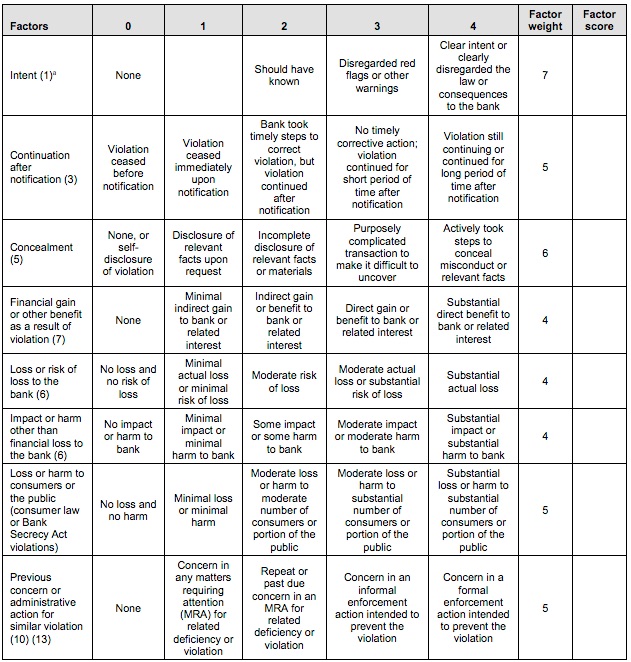
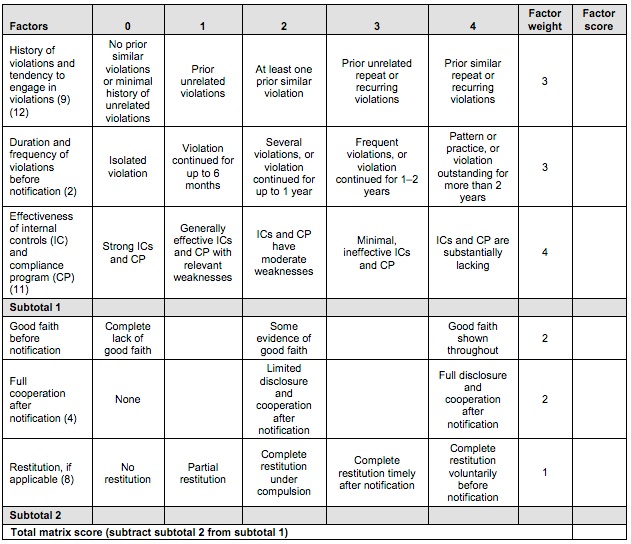
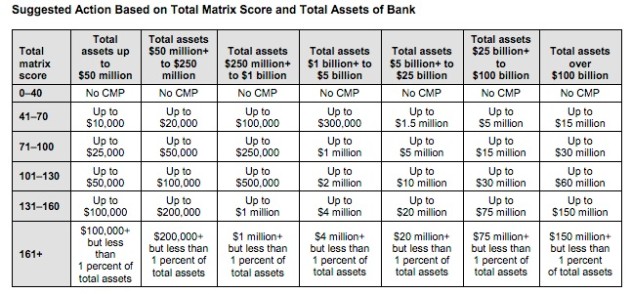
The Office of the Comptroller of the Currency (OCC) has issued revisions to its civil monetary penalty (CMP) policy that is in effect as of February 26, 2016. The revisions apply to national banks, bank service companies, service providers and federal savings associations.
The new policy includes a revised CMP Matrix that includes grading criteria and weighted scores for violations in four areas:
Banking laws/regulations
Conditions imposed in writing or covered by a written agreement
Unsafe or unsound practices
Breach of fiduciary duty
The matrix reveals the factors the OCC uses to determine the amount of CMP assessments, including — for the first time — the size of the institution, as well as the severity of the violation, history of past violations, existence and effectiveness of internal controls, loss or harm, and several other factors. The new policy manual also includes a schedule of penalties divided by asset size.
The new CMP Matrix is as follows:
The attorneys at Glass & Goldberg in California provide high quality, cost-effective legal services and advice for clients in all aspects of commercial compliance, business litigation and transactional law. Call us at (818) 888-2220, send an email inquiry to info@glassgoldberg.com or visit us online at glassgoldberg.com to learn more about the firm and to sign up for future newsletters.
In its Winter 2015 Supervisory Insights, the FDIC issued a clear warning to financial institutions that they must make cybersecurity a top priority and outlined the top cyber threats that banks need to monitor and address, including malware, distributed denial-of-service and compound attacks. The FDIC said that financial institutions must place immediate focus on:
Corporate Governance of Cybersecurity: A financial institution’s Board of Directors and executive management must create a corporate culture that prioritizes cybersecurity, managing cyber risk as they do any other business risk.
Training and Education: Financial institutions must educate employees, contractors and customers about cybersecurity threats, highlighting the risk in each business function. Everyone — from the Board to entry-level employees — should participate in mandatory cybersecurity awareness training, since it only takes a misstep from one person to put the entire enterprise at risk. Training should be specific to each job function. Internal programs to fix known and potential vulnerabilities (“patch management”) should be implemented. Organizations should use both internal and external audits to determine the effectiveness of their cybersecurity programs.
Regulatory Response and Resources: Organizations need to take advantage of regulatory agency resources like the FDIC’s “Cyber Challenge” and the FFIEC’s 2014 Security Assessment to develop effective cybersecurity programs and routinely self-assess.
California Data Breach Notification Requirements
As of January 1, 2016, California’s new data breach notification requirements are in effect and include:
Notification Format
A new format for data breach notices requires that the notice be in plain language, use at least 10 pt. type and be titled, “Notice of Data Breach.” In addition, the notice must include the following five headings:
What Happened
What Information Was Involved
What We Are Doing
What You Can Do
For More Information
Substitute Notice
California allows for “substitute notice” when a company must notify more than 500,000 residents or if the cost of a notification would exceed $250,000. The new law outlines how a company may provide substitute notice in California, including email, website posting for a minimum of 30 days and notifying statewide media as well as the California Department of Technology’s Office of Information.
However, if the breach only involves a resident’s username or email address for an online account in combination with the password or security question, then a company may notify the affected resident via email and advise them to change their password and security question.
Expanded Definitions
While California does not require a breach notice that involves encrypted data, the law has never previously defined “encrypted.” This has now been remedied with the following definition:
“Rendered unusable, unreadable, or indecipherable to an unauthorized person through a security technology or methodology generally accepted in the field of information security.”
In addition, the definition of “personal information” has been expanded to include license plate information or information that has been collected via an automated license plate recognition system when that information is associated with an individual’s name.
The attorneys at Glass & Goldberg in California provide high quality, cost-effective legal services and advice for clients in all aspects of commercial compliance, business litigation and transactional law. Call us at (818) 888-2220, send an email inquiry to info@glassgoldberg.com or visit us online at glassgoldberg.com to learn more about the firm and to sign up for future newsletters.
A recent decision by the U.S. Court of Appeals for the Fifth Circuit has caused a split with a prior Seventh Circuit decision on when a bankruptcy trustee may surcharge expenses for maintaining a property prior to abandonment.
Section 506(c) of the Bankruptcy Code allows the bankruptcy trustee to recover from a lender’s collateral any necessary expenses for preserving and disposing of that collateral “to the extent of any benefit” to the lender or if the lender consents to the expenses. In this case — Southwest Securities FSB v. Segner (In re Domistyle, Inc.) — the debtor was the owner of a Laredo, Texas, factory. The bankruptcy trustee believed that the property was worth more than what was owed to the lender, and attempted to sell it for approximately 14 months.
During that time, the trustee incurred expenses for utilities, roof repairs, security and other maintenance. Unfortunately, the property was overvalued and a buyer could not be found at a price that would result in any recovery to the estate. After 14 months, the trustee abandoned the sale of the property and turned it over to the lender. The trustee then sought to recover the expenses of maintaining the property from the lender during the time he tried to sell it.
A 1982 decision by the Seventh Circuit in In re Trim-X Inc. held that a lender can be charged expenses for a short period of time between when the trustee seeks and a court approves the abandonment. The Fifth Circuit ruled otherwise in Domistyle, concluding that “The necessary direct relationship between the expenses and the collateral is obvious here; all of the surcharged expenses related only to preserving the value of the Property and preparing it for sale.”
Even though the lender received no benefit from the 14-month delay while the trustee sought to sell the property, the court held that “there is no indication [the lender] could have sold the Property earlier and avoided these expenses,” in effect shifting the burden of proof as to whether the lender received a benefit from the trustee to the lender.
Following this decision, lenders should make every effort in similar situations to establish with the bankruptcy court that they are seeking and will conduct an immediate foreclosure sale in order to avoid excess surcharges from a protracted sale process.
The attorneys at Glass & Goldberg in California provide high quality, cost-effective legal services and advice for clients in all aspects of commercial compliance, business litigation and transactional law. Call us at (818) 888-2220, send an email inquiry to info@glassgoldberg.com or visit us online at glassgoldberg.com to learn more about the firm and to sign up for future newsletters.

 In a case of first impression, the U.S. Court of Appeals for the Seventh Circuit has ruled that the termination of two leases prior to a commercial tenant’s bankruptcy filing were transfers under the Bankruptcy Code and thus avoidable.